

Science
“We have the opportunity to create the future and decide what that’s like” - Mae Jemison, former NASA astronaut, engineer, physician and the first black woman to travel into space.
At SS Peter & Paul, we are scientists — and every child’s question matters.
At SS Peter & Paul Catholic Primary School, we are scientists. Our science curriculum nurtures curiosity, enquiry and critical thinking, empowering children to question, explore and explain the world around them. As a Primary Science Quality Mark (PSQM) Gilt award school, we build on our established strengths to continually refine and enrich science provision.
Our science mascot, DRAKE, brings our core principles to life: Discovery, Real-life, Active, Kinaesthetic and Enquiry-based learning. Early Years provides the essential foundations, developing observation, questioning and exploration through play and first-hand experiences. Building systematically on these foundations, our curriculum deepens pupils’ knowledge of biology, chemistry and physics alongside their ability to work scientifically. Big questions give learning a clear purpose, encouraging children to investigate ideas, challenge their thinking and use evidence to explain their findings. We want pupils to recognise the relevance of science to everyday life and develop the knowledge, confidence and curiosity to understand and contribute to an ever-changing world.
Science is for every child, regardless of background, starting point or additional need. Our inclusive curriculum combines high expectations with carefully adapted teaching and meaningful practical experiences, enabling all pupils to participate, achieve and see themselves as capable scientists. Drawing on Oak National Academy planning and resources, we refine teaching to meet our pupils’ needs, strengthen connections with prior learning and deepen scientific understanding over time. Our emphasis on scientific vocabulary, explaining ideas and guided enquiry reflects the Education Endowment Foundation’s recommendations for effective primary science teaching. We place a strong emphasis on purposeful retrieval, regularly revisiting key knowledge and vocabulary so that pupils know more, remember more and apply their learning with increasing confidence.
Enquiry cartoons make the five scientific enquiry types explicit, helping children understand how scientists investigate different questions and why particular approaches are appropriate. Through purposeful discussion, collaboration and the progressive development of scientific vocabulary, pupils learn to predict, observe, measure, interpret evidence and communicate conclusions with increasing precision and independence. We build on our established practice to sustain enthusiasm for science and ensure every child’s ideas, questions and discoveries are valued. At SS Peter & Paul, your child’s curiosity is treasured, their potential is nurtured and their next question could be the beginning of something extraordinary.
Teachers assess continuously through prior-knowledge checks, retrieval, questioning and discussion, identifying gaps and misconceptions as they arise. Each unit’s Big Question is checked through Drake’s Challenge, our adapted exit quiz, and half-termly summative assessments sit alongside practical work and children’s own spoken and written explanations. Because some children show what they know more easily in talk than on paper, teachers deliberately consider barriers to language or recording when judging scientific understanding. Subject leadership reviews planning, books, lessons and pupil voice across the year, including the experience and progress of pupils with SEND, to guide support and improve the curriculum.
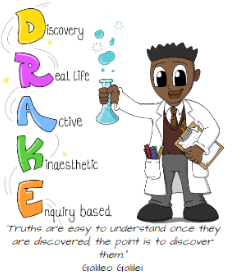
D- Discover
R- Relate to real life experiences
A- Active participants
K- Kinaesthetic in their learning (“hands on”)
E- Enquiry based on their learning